
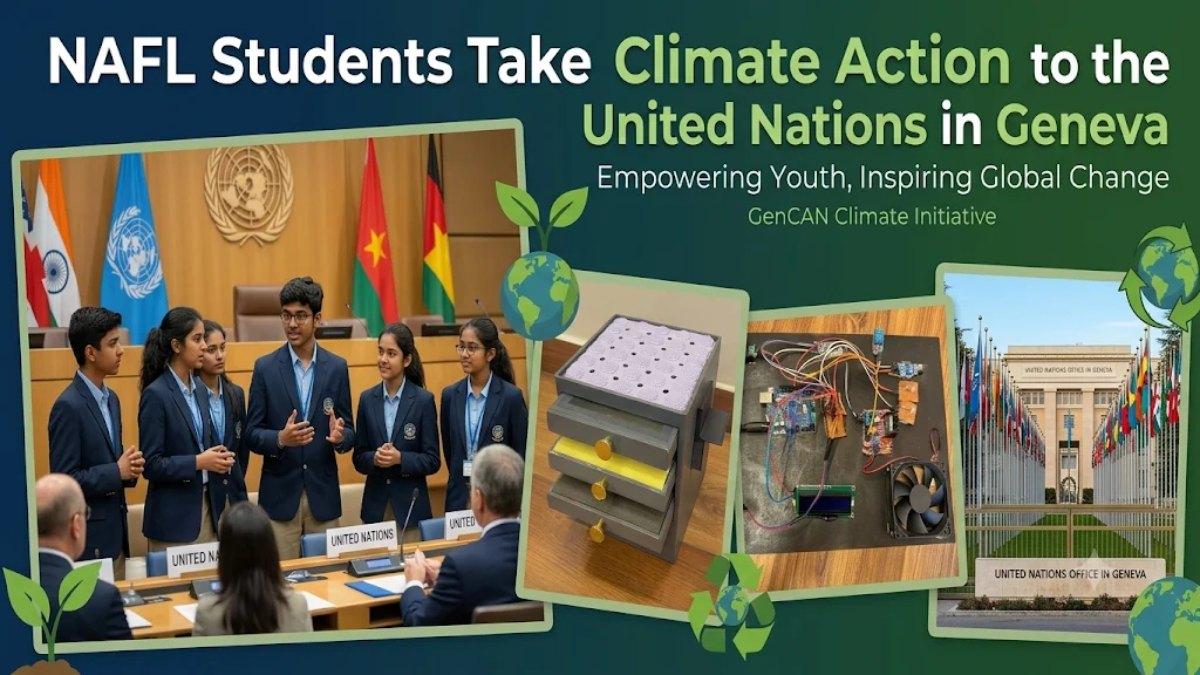
Students of the National Academy for Learning (NAFL), Basaveshwarnagar, Bengaluru, are preparing to take their environmental initiatives to an international platform at the United Nations in Geneva this November. Two student teams from the school will present projects addressing water conservation and responsible energy consumption, highlighting how young people are developing practical solutions to environmental challenges.
The initiatives, Project Niraa and Project Urja, have been developed with the support and mentorship of 1M1B (One Million for One Billion), a United Nations-accredited non-profit organisation that works with young people to create social impact through innovation, technology and entrepreneurship.
The students are participating in Youth Climate Diplomacy, an initiative under 1M1B's 1.5 Matters campaign. The programme encourages young people to contribute to global climate action and support the objectives of the Paris Climate Agreement.
Mrs. Indira Jayakrishnan, Mentor Principal at National Academy for Learning, described the opportunity as an important milestone for the school. She highlighted its commitment to nurturing environmentally conscious and socially responsible young people who can translate classroom learning into meaningful action.
Project Niraa: Students Develop a Solution for Water Conservation
One of the initiatives, Project Niraa, focuses on water conservation and sustainable sanitation through a working prototype called AquaStep.
The device is designed to collect, filter, and store greywater from kitchen sinks and showers so that it can be reused for non-drinking purposes. The idea addresses growing concerns about water scarcity and the need to make better use of household wastewater.
During five weeks of testing across several households, the students conserved approximately 1,000 litres of water. The results have encouraged the team to explore the possibility of expanding the initiative.
The current AquaStep prototype has a storage capacity of three litres. The students plan to increase this to five litres during large-scale production.
The team also aims to deploy 50 AquaStep units, with an estimated potential to conserve approximately 3,750 litres of water every day and 1.5 million litres annually.
Through Project Niraa, the students hope to demonstrate that relatively simple technological solutions can encourage responsible water consumption and generate measurable benefits for households and communities.
Project Urja: Encouraging Smarter Electricity Consumption
The second initiative, Project Urja, addresses unnecessary electricity consumption, particularly in commercial spaces where lights and fans are sometimes left operating even when rooms are unoccupied.
Inspired by United Nations Sustainable Development Goal 12, which promotes Responsible Consumption and Production, the students have developed a hardware device that detects human presence and automatically controls lights and fans.
The solution aims to make energy management more affordable and accessible while reducing electricity wastage. Rather than focusing only on cleaner energy generation, the project highlights the importance of using available resources more efficiently.
Alongside developing the device, the students have undertaken research, interacted with industry professionals, and engaged with communities to understand practical challenges associated with energy efficiency and net-zero goals.
The initiative has also reached a wider audience through awareness activities and digital engagement.
Some of its key achievements include:
Reaching more than 500 students through sustainability awareness programmes
Generating engagement from over 300 people across Instagram, LinkedIn, Medium and YouTube
Conducting interviews with professionals from different sectors
Participating in sustainability discussions and launching an interactive website to share research and encourage energy conservation
These activities have helped the students understand how technology, public awareness and community participation can work together to address environmental concerns.
NAFL Students Take Classroom Learning to a Global Platform
The participation of the two NAFL teams in Geneva reflects the growing role of students in identifying environmental problems and developing solutions beyond conventional classroom activities.
Both projects combine scientific thinking, research, practical experimentation, and community engagement. They also demonstrate how schools can encourage learners to explore global challenges while developing the confidence to present their ideas on international platforms.
Through Youth Climate Diplomacy, the students will have an opportunity to share their work, participate in wider discussions on sustainability, and gain perspectives that could help them improve their initiatives.
The projects also highlight two everyday areas where individual and community action can make a difference. While AquaStep focuses on reducing household water wastage, Project Urja addresses unnecessary electricity consumption in commercial environments.
As the teams prepare for their presentation, their initiatives offer an encouraging example of how young innovators can turn environmental awareness into practical action.
About National Academy for Learning
National Academy for Learning (NAFL), located in Basaveshwarnagar, Bengaluru, is an educational institution committed to academic excellence, holistic development, and nurturing independent, responsible learners. The school encourages inquiry, innovation, collaboration and real-world engagement to help students develop the knowledge, skills and values required to contribute meaningfully to society.
About 1M1B
1M1B (One Million for One Billion) is a United Nations-accredited non-profit organisation founded in 2014. It works to empower young people through emerging technologies, sustainability, digital citizenship and entrepreneurship. Its Youth Climate Diplomacy initiative, part of the 1.5 Matters campaign, encourages student-led projects that contribute to global climate goals. EducationNewsNetwork brings attention to initiatives that demonstrate the potential of student participation in addressing real-world challenges. The NAFL projects show how young people can contribute to environmental conversations through research, innovation, and practical community-based solutions, while taking their ideas beyond school boundaries.
No comments yet. Be the first to share your view.